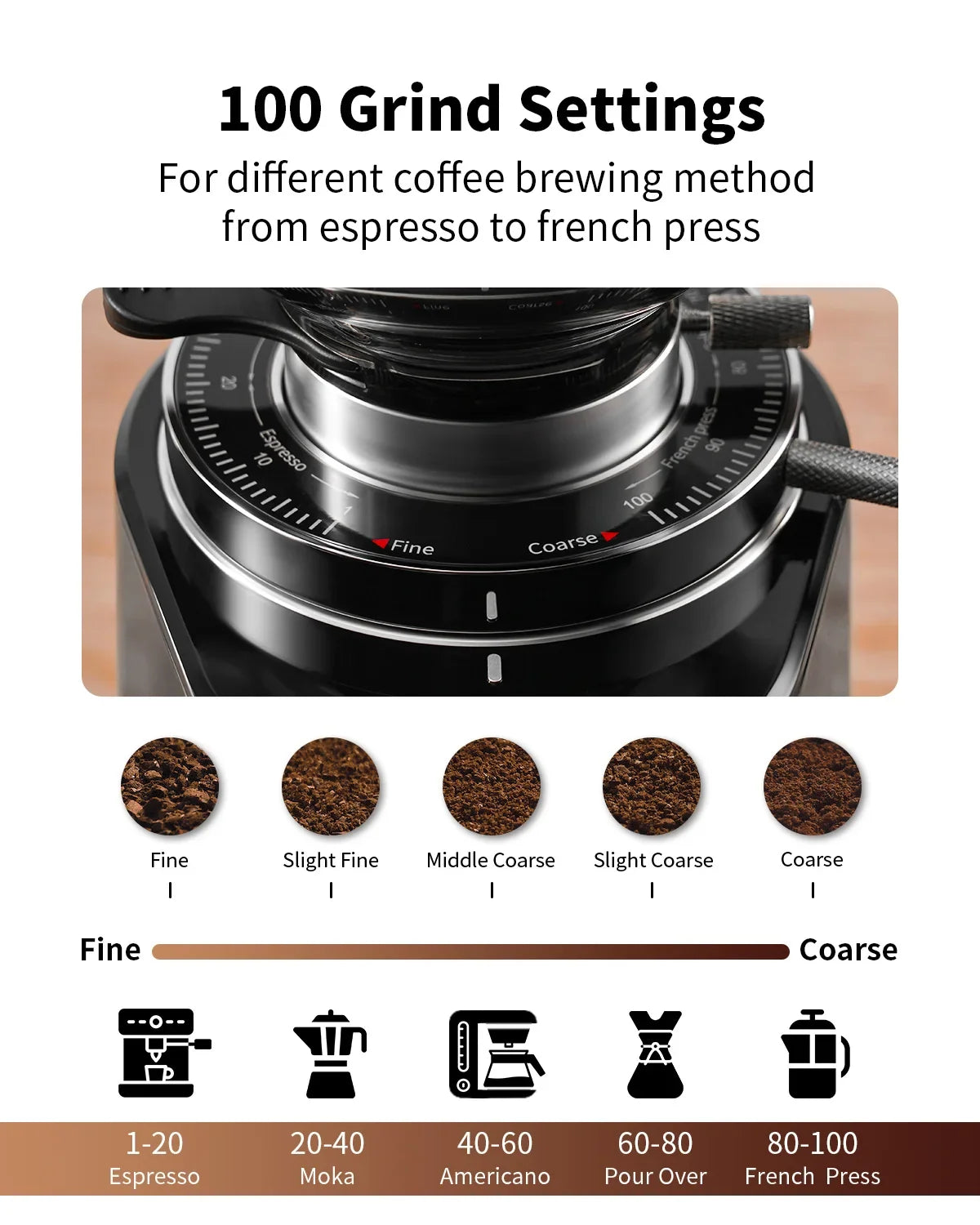
The numbers on a burr coffee grinder are positions on that grinder’s adjustment scale. They usually show how the burrs move from finer to coarser grinding, but they are not universal grind-size measurements. Setting 10 on one grinder can produce very different grounds from setting 10 on another. Use the numbers as repeatable reference points for your own grinder, then adjust from the way your coffee brews and tastes.
What Does a Burr Grinder Setting Actually Control?
A grind setting changes the space between the burrs, which changes how finely the beans are broken apart. Moving the burrs closer generally produces finer grounds, while moving them farther apart produces coarser grounds.
The printed number is usually a position on that adjustment system. It is not the diameter of every coffee particle coming out of the grinder. Coffee breaks into a mix of particle sizes, so even one setting produces both larger and smaller pieces.
Research on coffee grinding describes a grinder number as an arbitrary grind-size setting rather than a standardized particle measurement. This is why a recipe that says “use setting 12” is incomplete unless it also tells you which grinder was used.
Grind size still matters once you find the right position on your own dial. Finer grounds expose more surface area to water and generally extract faster, while coarser grounds extract more slowly. The grinder number simply gives you a way to return to the position that produced that grind.
Does a Lower Number Always Mean a Finer Grind?
No. Do not assume lower always means finer or higher always means coarser until you check your grinder. Many home grinders use that direction, but the scale is designed by the manufacturer and is not an industry standard.
Look for labels such as:
- Fine and coarse markings
- Espresso, drip, or French press icons
- Arrows showing which direction to turn
- A grind-setting chart in the manual
If your grinder says that setting 1 is the finest position, moving upward will normally make the grounds coarser on that model. Another grinder may use a different scale or adjustment system.
Also make sure you are looking at the grind-size control rather than another number on the machine. Some electric coffee grinders also display grinding seconds, cup quantity, or dose settings. Changing a timer changes how long the motor runs; it does not necessarily change the space between the burrs.
This distinction is useful when learning how to use a coffee grinder. Find the control that changes grind size first, then treat timer or cup settings as separate controls for how much coffee is ground.
Why Is Setting 10 Different on Two Coffee Grinders?
Setting 10 only has meaning on the grinder where it appears. Different grinders can have different burrs, adjustment ranges, step sizes, and calibration points.
Three differences matter most:
- Adjustment range: One grinder may have 16 total positions while another has 100.
- Step size: Each click on a 16-setting grinder usually represents a larger move through its total range than one click on a finely stepped grinder.
- Burr design and calibration: Different burr shapes and starting positions can produce different particle distributions even when the printed numbers look similar.
That means setting 10 could sit near the middle of one grinder’s useful range but close to the fine end of another.
SHARDOR’s current burr grinder lineup makes this easy to see. The burr coffee grinder collection includes models with 16, 32, 48, and 100 grind settings. Those numbers describe how many adjustment positions each grinder offers; they do not mean setting 10 produces the same coffee on all four machines.
More settings mainly give you more positions between the grinder’s fine and coarse ends. A 100-setting burr grinder can offer smaller adjustment steps than a grinder with fewer positions when you need to fine-tune a recipe. That does not make “setting 37” a universal pour-over size or “setting 8” a universal espresso size.
A 16-setting burr grinder with fewer positions can still fit a straightforward home routine well. More adjustment becomes especially useful when you switch between several brewing methods or when small grind changes noticeably affect the result.
How Do You Find a Useful Starting Point for Your Brewing Method?
Start with the range recommended for your grinder, then adjust from the actual brew. Do not copy an exact setting from another grinder and expect it to match. You only need a broad starting direction:
| Brewing Method | General Grind Direction |
|---|---|
| Espresso | Fine |
| Moka pot | Medium-fine |
| Pour-over | Medium-fine to medium |
| Drip coffee | Medium |
| French press | Coarse |
| Cold brew | Coarse |
These are starting ranges, not fixed numbers. The manual may show a suggested band for each method, such as several settings for pour-over rather than one exact position.
Once you brew, let the result move the dial. If a pour-over drains very quickly and tastes thin, try slightly finer. If it drains slowly and tastes harsh, move slightly coarser. Espresso also responds to small grind changes, so move in small steps rather than jumping across the dial.
This is why copying a forum comment like “setting 12 works perfectly” can be misleading. Even if the other person makes the same type of coffee, their grinder, beans, dose, and recipe may be different.
If you regularly make pour-over, using flow and taste to adjust grind gives you a more useful target than trying to match another person’s dial number.
How Do You Record Grinder Settings That Work for Your Coffee?
Write down the setting that works for each coffee and brewing method. The value of grinder numbers is that they give you a reference you can return to later. A simple note might look like this:
| Coffee | Method | Setting | What Happened |
|---|---|---|---|
| Medium roast | Drip | 18 | Balanced |
| Same beans | Pour-over | 15 | Good flow |
| Dark roast | French press | 27 | Clean, full cup |
The actual numbers in your notebook will depend entirely on your grinder. Their value comes from helping you repeat a result, not from matching a universal chart.
Keep the other parts of the recipe reasonably stable while finding the setting. If you change grind size, coffee dose, water amount, and brewing time at once, you will not know which change improved the cup.
The right setting can also move when you open a different bag of beans. Roast level, freshness, and bean structure can change how coffee behaves during grinding and brewing, so treat an old setting as a useful starting point rather than a permanent rule.
A short note on your phone is enough. Record the coffee, brewing method, and grinder position, then update it if the next bag needs a small change. This is the practical value of having numbered settings: you can repeat what worked without starting from zero every morning.
Use the Number as a Reference, Not a Universal Recipe
The numbers on a burr grinder help you move between finer and coarser positions and return to settings that worked before. They do not describe one universal particle size, and the same number can mean something very different on another grinder. Start with the range recommended for your machine, brew the coffee, and adjust in small steps. More settings give you more room to fine-tune, but the useful number is always the one that works with your grinder, beans, and recipe.

FAQs About Burr Coffee Grinder Settings
Q1. What Number Should a Coffee Grinder Be Set To?
There is no universal number for every grinder. Start with the range your grinder recommends for your brewing method, then move finer or coarser based on brew flow and taste.
Q2. Does a Higher Grinder Number Mean a Coarser Grind?
It does on many grinders, but not all adjustment scales use the same direction. Check the fine/coarse markings or manual for your specific model before using the number as a reference.
Q3. Do Coffee Grinder Numbers Mean the Same Thing Across Brands?
No. The numbers are positions on each grinder’s own adjustment system. Setting 10 on one grinder can produce a very different grind from setting 10 on another.
Q4. Are More Grind Settings Better?
More settings give you more adjustment positions, which can make small changes easier. That can be useful for espresso or for switching among several brewing methods, but the number of settings alone does not determine grind quality.
Q5. What Is the Zero Point on a Burr Grinder?
The zero point usually refers to the finest end or a reference point near where the burrs are closest, depending on the grinder design. Follow your model’s instructions rather than forcing the adjustment past its normal limit.