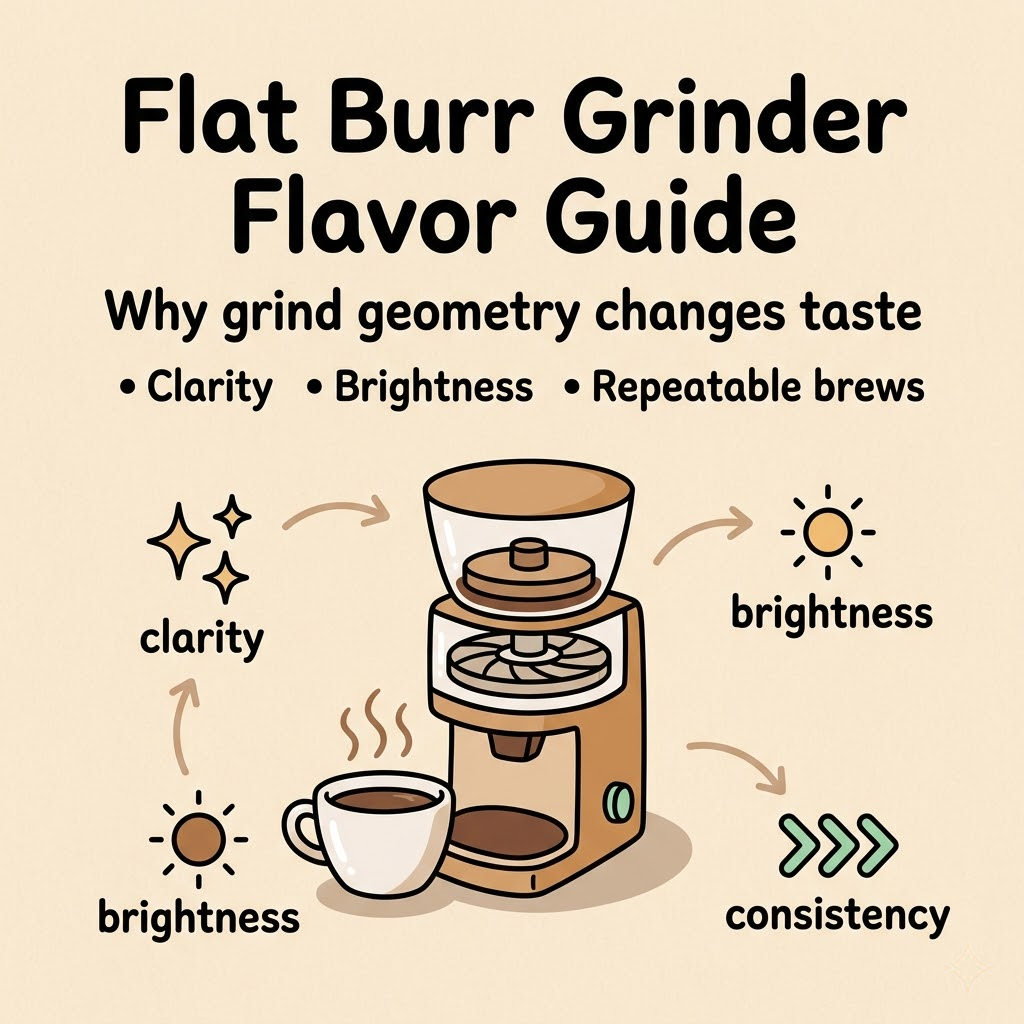
Most coffee drinkers obsess over beans and brew ratios, but overlook the grinder. The truth is, your grinder shapes the flavor in your cup more than almost anything else. A flat burr coffee grinder produces a distinctly different taste compared to other grinder types, and once you know why, it's hard to ignore. Here's a clear look at what flat burr grinding actually does to your coffee's flavor.
How a Flat Burr Coffee Grinder Works
Before getting into flavor, it helps to know what makes a flat burr grinder different from other designs at a mechanical level. The burrs (the two grinding surfaces inside the machine) are the heart of any coffee grinder, and their shape determines everything from grind consistency to heat generation.
The Flat Burr Design and Why It Matters
A flat burr grinder uses two horizontal, disc-shaped burrs that face each other. Coffee beans are fed through the center and ground outward between the two flat surfaces. Because the grinding area is wide and even, every bean passes through the same grinding zone at the same time.
This geometry is what gives flat burr grinders their reputation for precision. The contact between the two burrs is consistent across the entire surface, which means the force applied to the beans is uniform. The result is a more controlled, predictable grind from start to finish.
How It Compares to a Conical Burr Setup
A conical burr grinder, by contrast, uses a cone-shaped inner burr that sits inside a ring-shaped outer burr. Beans travel downward through the gap between the two. The grinding angle changes slightly as beans move through, which can produce a slightly wider range of particle sizes.

Key differences between the two designs:
- Grinding geometry: Flat burrs grind horizontally across a wide surface; conical burrs grind at an angle along a curved path
- Particle uniformity: Flat burrs tend to produce a narrower, more uniform particle size distribution
- Heat generation: Flat burrs can spin faster and still maintain low heat output when the burr diameter is large enough, such as 64mm
- Flavor character: Flat burrs are generally associated with brighter, more separated flavor notes; conical burrs often produce a slightly rounder, fuller cup
Neither design is universally better. They simply produce different results, and the preference often comes down to the type of coffee you make most.
What a Flat Burr Grinder Does to Your Coffee Grounds
The way a grinder breaks down coffee beans has a direct impact on how those grounds behave during brewing. Grind consistency, which refers to how similar the particles are in size, is one of the most important factors in producing a well-extracted cup.
Uniform Particle Size and What It Means for Extraction
Extraction is the process by which water pulls flavor compounds out of ground coffee. When particle sizes are uneven, small particles (called fines) extract too quickly and can contribute bitterness, while larger particles extract too slowly and can taste weak or sour. This is called uneven extraction, and it muddies the flavor of the final cup.
A flat burr coffee grinder minimizes this problem by producing grounds where the particles are highly consistent in size. When all the particles are roughly the same, water moves through them at an even rate and extracts flavor compounds in a more balanced way.
How Consistent Grounds Affect Your Cup
The practical effect of uniform grinding shows up directly in taste. A well-ground, evenly distributed coffee bed allows for:
- Cleaner extraction with fewer off-notes from over- or under-extracted particles
- Better clarity, meaning individual flavor notes like fruit, chocolate, or floral tones are easier to distinguish
- More predictable results across multiple brews, so dialing in a recipe actually works
This is why flat burr grinders are a common choice among home baristas who want repeatable, café-level results at home.
The Flavor Benefits of Using a Flat Burr Coffee Grinder
Flat burr grinding has a distinct flavor signature that sets it apart from other grind methods. These characteristics show up consistently enough that experienced coffee drinkers can often identify flat-burr-ground coffee by taste alone.
Flavor clarity refers to how distinctly individual taste notes come through in a cup. A coffee with high clarity lets you taste the difference between a fruity Ethiopian bean and a nutty Colombian one. Flat burr grinders are known for producing exactly this kind of separation, because uniform grounds and even extraction allow each coffee's unique characteristics to come through without blending into a generic background.
Key flavor benefits of a flat burr coffee grinder:
- Brightness: A lively, clean quality in the cup that makes coffee taste fresh rather than flat. This is not sourness — it is the natural vibrancy of a well-extracted coffee.
- Flavor separation: Individual tasting notes like fruit, chocolate, or floral tones are easier to distinguish rather than muddled together.
- Consistency: Because particle size is uniform, the flavor you dial in stays repeatable across multiple brews.
- Clarity in espresso and pour-over: Both methods are highly sensitive to grind consistency, and flat burr grounds make the flavor of the bean's origin noticeably more expressive in the final cup.
Best Brewing Methods for a Coffee Burr Grinder
A flat burr coffee grinder covers a wide range of brewing methods thanks to its wide grind range. The table below shows how different brewing methods map to grind size and what each one brings out in a flat burr grind.
Different brewing methods call for different grind sizes, and a quality coffee burr grinder with a wide settings range gives you the flexibility to move between them without switching equipment.
| Brewing Method | Grind Size | Flavor Character with Flat Burr Grounds |
| Espresso | Extra fine | Intense, layered, high clarity |
| Moka pot | Fine | Bold, rich, concentrated |
| Pour-over | Medium fine | Bright, clean, origin-forward |
| Drip coffee | Medium | Balanced, smooth, consistent |
| French press | Coarse | Full-bodied, rounded |
| Cold brew | Extra coarse | Mellow, sweet, low acidity |
A flat burr grinder with a wide range of grind settings handles all of the above well. The key is being able to make small, precise adjustments between settings, especially for methods like espresso where even minor changes in grind size affect the outcome noticeably.
Grind Better, Taste More
A flat burr coffee grinder does something that most kitchen appliances don't: it actively improves the flavor of what you make, every single time you use it. The combination of uniform particle size, precise extraction, and clear flavor separation adds up to a noticeably better cup. Whether your daily drink is espresso, pour-over, or drip, a quality flat burr grinder is one of the most impactful changes you can make to your home coffee setup. Find the grinder that matches your brewing style and start tasting what your coffee is actually capable of.
FAQs about Coffee Grinders and Beans
Q1. How Often Should I Change Coffee Burrs?
Burr lifespan depends on how frequently you grind and the hardness of the beans you use. As a general rule, flat burrs in home grinders tend to last for several hundred pounds of coffee before any noticeable decline in grind consistency. Signs that burrs may need replacing include a duller grind, uneven particle size, or a drop in flavor clarity. Checking the manufacturer's recommendation for your specific grinder is the best starting point.
Q2. Are Flat Burrs Harder to Clean?
Flat burrs are generally straightforward to clean, especially on grinders designed with removable upper burrs and accessible grinding chambers. Regular brushing after use prevents coffee oil buildup, which can turn rancid over time and affect flavor. Many flat burr grinders also include a grounds press or bellows to clear residual grounds from the grinding chamber after each use.
Q3. What Coffee Grinders Do Coffee Shops Use?
Most specialty coffee shops use commercial-grade flat burr grinders for espresso because of the consistent particle size and high flavor clarity they produce. These grinders typically feature larger burr diameters to handle high-volume grinding with minimal heat buildup. For filter coffee and pour-over stations, cafes may use either flat or conical burr grinders depending on the flavor profile they want to achieve.
Q4. What Is the Enemy of Coffee Beans?
The four main threats to coffee bean quality are heat, moisture, light, and oxygen. Any of these can accelerate the staling process and degrade the aromatic compounds that give coffee its flavor. Storing beans in an airtight, opaque container at room temperature away from direct sunlight is the most effective way to preserve freshness. Grinding just before brewing also helps, since ground coffee loses its volatile aromas much faster than whole beans.