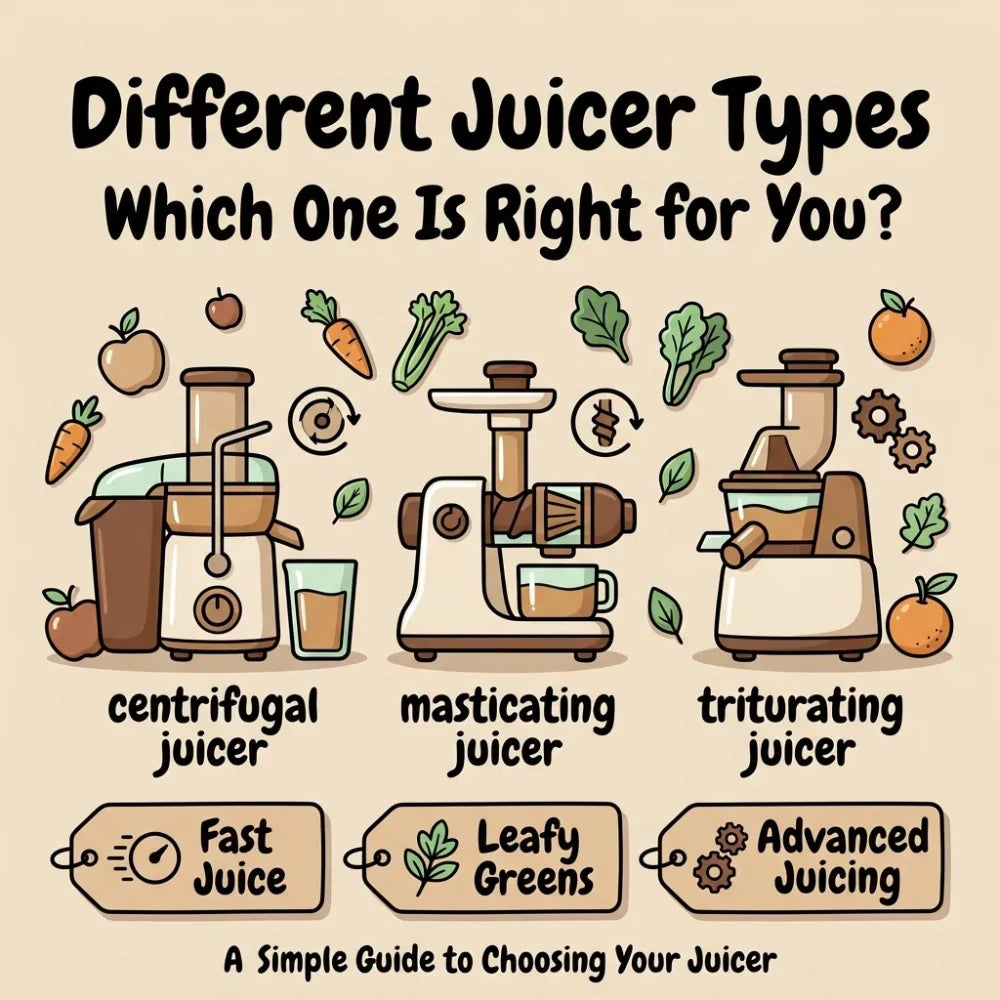
Walk into any kitchen appliance aisle and the number of juicer options can feel overwhelming. Each type promises something different, and choosing the wrong one means a machine that ends up collecting dust instead of making juice. Knowing the difference between the main juicer types saves you money, time, and a lot of frustration. Here is a straightforward breakdown of what each type actually does and how to figure out which one fits your life.
The Main Juicer Types and How They Work
There are three main juicer types, and each extracts juice in a different way. That difference affects juice quality, yield, speed, and how much effort the machine takes to maintain.
Centrifugal Juicers: Fast and Easy for Everyday Use
A centrifugal juicer spins a flat cutting blade at high speed to shred produce, then separates juice through a mesh basket using centrifugal force (the outward force created by spinning). The whole process takes seconds.
These juicers handle hard fruits and vegetables well, including apples, carrots, and beets. Wide feed chutes on many models reduce prep time since large pieces can go straight in. The high-speed process does introduce more heat and air into the juice compared to slower methods, but for most people who drink their juice right away, this is not a major concern.
Masticating Juicers: A Slower Option for Leafy Greens
A masticating juicer uses a slow-turning auger to crush and press produce against a mesh screen. This slower process may help reduce oxidation and can work well for leafy greens, wheatgrass, and soft herbs. However, masticating juicers usually take longer to use, cost more, and have more parts to clean.
Triturating Juicers: A Niche Option for Advanced Juicing
A triturating juicer uses two interlocking gears to crush and press produce slowly. This design can produce a high juice yield and works well with ingredients like leafy greens and wheatgrass. However, triturating juicers are usually expensive, bulky, slower to use, and more complex to clean. For most home users who want quick juice with less prep and cleanup, a centrifugal juicer is usually the more practical everyday choice.
How Juicer Types Compare for Everyday Use
Different juicer types perform differently depending on the ingredients you use most often and how much time you want to spend on juicing and cleanup. For most home users, the most important factors are speed, ease of cleaning, produce compatibility, and overall cost.
| Factor | Centrifugal juicers | Masticating juicers | Triturating juicers |
| Best for | Quick daily juice | Leafy greens and slower juicing | Advanced, high-volume juicing |
| Hard fruits and vegetables | Excellent | Good | Very good |
| Leafy greens | Works best when mixed with firmer produce | Very good | Very good |
| Juicing speed | Fastest | Slow | Slowest |
| Ease of cleaning | Easiest | Moderate | Most involved |
| Price range | Most affordable | Mid to high | Highest |
As the table shows, centrifugal juicers are especially practical for people who want fresh juice quickly and do not want a complicated cleanup routine. Masticating and triturating juicers may be better for users who juice leafy greens often or need a more specialized machine, but they usually require more time, space, and budget.

What to Know About Centrifugal Juicers Before You Buy
Centrifugal juicers are a popular starting point for many home juicers because they are fast, simple, and easy to fit into a daily routine. If you are new to juicing or want a machine that fits into a busy daily routine without much fuss, a centrifugal juicer covers the basics efficiently.
Key things worth knowing before choosing a centrifugal juicer:
- Feed chute size matters. A wider feed chute means less time spent cutting produce before juicing. Models with large feed chutes can accommodate whole apples, whole beets, and large chunks of ginger without pre-cutting. For example, Shardorlife’s 1300W centrifugal juicer comes with a 3.4-inch wide feed chute, which is useful if you want to spend less time chopping apples, carrots, beets, or other firm produce before juicing.
- Speed settings affect results. Many centrifugal juicers offer two speed settings: low for soft fruits and high for hard produce. Using the right speed for the ingredient improves juice yield and reduces splashing. A model with dual speed settings, such as Shardorlife’s 1300W centrifugal juicer, can be especially helpful if you switch between softer fruits like oranges and tomatoes and firmer produce like apples, carrots, celery, or kale.
- Pulp collection and capacity. A larger pulp container means you can juice more before stopping to empty it, which matters if you juice in batches.
- Cleaning is straightforward. Most centrifugal juicers have dishwasher-safe parts or components that rinse clean quickly under running water. This is one of the biggest practical advantages over other juicer types for daily use.
Centrifugal juicers are particularly well suited for people who primarily juice hard fruits and vegetables, want fast results with minimal prep, and prefer a machine that is easy to maintain.
How to Choose the Right Juicer Type for Your Lifestyle
Choosing the right juicer comes down to what you juice, how often, and how much time you want to spend on prep and cleanup.
- You want fast, simple juice every morning: A centrifugal juicer is the most practical choice. It handles hard fruits and vegetables quickly, is easy to clean, and is the most affordable of the three types.
- You juice leafy greens, celery, or wheatgrass regularly: A masticating juicer may be worth considering if these ingredients are your main focus and you do not mind a slower process, higher price, and extra cleanup.
- You juice in large volumes and want a more specialized machine: A triturating juicer may suit serious juicing enthusiasts, but it is usually expensive, bulky, slow, and more involved to clean.
- You are considering a "super juicer": This term refers to multi-functional machines that can make nut milks, sorbets, and more in addition to juice. They offer versatility but tend to be bulkier and more complex. For most people who primarily want fresh juice, a dedicated juicer that does one thing well is the more practical choice.
The clearest indicator of the right juicer is how you actually plan to use it every day, not the most impressive spec sheet.
Find the Juicer That Fits Your Routine
Every juicer type has its place, but the right choice depends on how you plan to use it every day. Centrifugal juicers are a practical fit for busy home routines because they make juice quickly, handle common fruits and vegetables well, and are usually easier to clean. Masticating juicers may suit people who often juice leafy greens, while triturating juicers are better for serious, high-volume juicing. If you want fresh juice without a complicated process, a centrifugal juicer is a smart place to start.
FAQs about juicer types and juicing
Q1. Which Is Better, Cold Press Juicer or Centrifugal Juicer?
Neither is universally better. A cold press juicer, also called a masticating juicer, is often preferred for leafy greens and slower extraction. A centrifugal juicer is faster, easier to clean, and more affordable, making it a practical choice for everyday juice with common fruits and vegetables. The better option depends on what you juice most often and whether you value speed and convenience or a slower, more specialized process.
Q2. What Is the 80/20 Rule in Juicing?
The 80/20 rule in juicing refers to making roughly 80 percent of your juice from vegetables and 20 percent from fruits. The idea is to limit natural fruit sugars while still getting the flavor benefits that fruits provide. Vegetables like cucumber, celery, and spinach form the bulk of the juice, while a small amount of apple, lemon, or ginger adds taste without significantly raising the sugar content of the drink.
Q3. Do Centrifugal Juicers Destroy Nutrients?
Centrifugal juicers do not destroy nutrients entirely. Their high-speed process can introduce more air into the juice than slower juicing methods, which may affect some heat- or oxygen-sensitive nutrients over time. However, for most people who drink their juice soon after making it, a centrifugal juicer still provides a fresh, nutritious drink from whole fruits and vegetables.
Q4. How Easy Are Centrifugal Juicers to Clean?
Centrifugal juicers are generally the easiest juicer type to clean. Most models have a small number of removable parts that either rinse clean under running water in a few minutes or are dishwasher safe. The mesh filter basket requires a brush to remove pulp residue, but the process is quick compared to masticating or triturating juicers. Rinsing the parts immediately after use makes cleanup significantly faster.