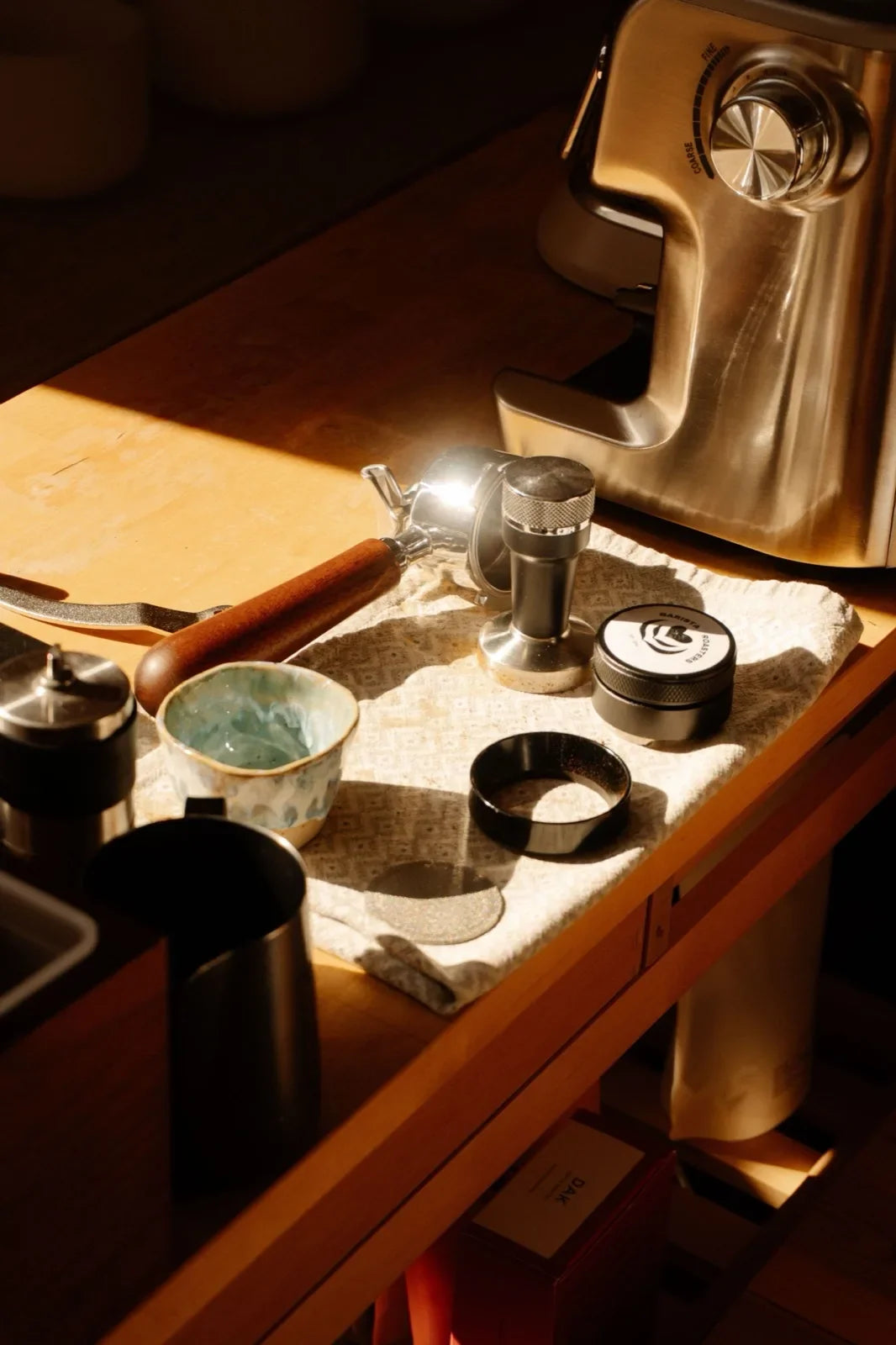
You do not need a counter full of espresso tools to make good coffee at home. Beyond the espresso machine, the most useful starting home barista espresso setup is an espresso-capable grinder, a small digital scale, and a tamper that fits your basket. Add a milk pitcher if you make lattes or cappuccinos. WDT tools, dosing funnels, knock boxes, and other accessories can come later when they solve a problem you actually notice.
Quick Takeaways
| Tool | Priority | Why It Matters |
|---|---|---|
| Espresso-capable grinder | Essential for whole beans | Lets you adjust grind size |
| Digital scale | High priority | Measures dose and espresso yield |
| Correct-size tamper | Essential | Creates a level, compressed coffee bed |
| Milk pitcher | Needed for milk drinks | Helps steam and pour milk |
| WDT tool | Useful upgrade | Breaks up clumps and evens distribution |
| Dosing funnel | Convenience | Keeps grounds inside the basket |
| Knock box | Convenience | Makes used puck disposal easier |
| Bottomless portafilter | Buy later | Helps you see extraction problems |
| Puck screen | Optional | Can help keep the group area cleaner |
| Replacement parts | As needed | Replace worn or damaged machine parts |
Start with the tools that make your recipe measurable and repeatable. Add the rest after you know what is slowing down or making your daily espresso routine harder.
What Do You Actually Need to Start Making Espresso at Home?
For most beginners, the basic setup is simpler than it looks: machine, grinder, scale, and a correctly fitting tamper. Milk-drink fans should also have a steaming pitcher.
The grinder matters because espresso needs small grind changes. If a shot runs too fast or too slowly, adjusting the grind is one of the main ways to correct it. If you use an espresso machine with a built-in grinder, you may not need another one.
A digital scale is the next useful tool. Espresso recipes are commonly tracked by coffee dose, espresso yield, and shot time. For example, weighing the dry coffee and the espresso in the cup gives you a repeatable recipe instead of relying on how full the basket or cup looks.
A tamper is also part of the basic workflow. It should fit the filter basket well enough to press the coffee bed evenly. If your espresso machine already comes with a tamper that fits and feels comfortable, use it before buying another one.
That simple setup is also close to what is used in formal barista training. A typical training station includes a 0.1 g scale, tamper, milk pitchers, and knock box, along with the machine and grinder.
If you are still learning the basic sequence, getting grind, dose, tamp, and shot timing under control will usually help more than adding several new tools at once.
Espresso Accessories vs Replacement Parts: What’s the Difference?
Accessories help you prepare coffee or make the workflow easier. Replacement parts keep the machine working correctly when an original component wears out, breaks, or needs to be replaced.
The two categories often appear together online, which can make shopping confusing.
Accessories Support the Brewing Routine
Common accessories include:
- Digital scales
- Tampers
- WDT tools
- Dosing funnels
- Milk pitchers
- Knock boxes
- Tamping mats
- Puck screens
- Bottomless portafilters
These tools change how you dose, prepare, steam, clean, or observe the coffee. Some can improve repeatability, while others mostly make the workflow cleaner or easier.
Replacement Parts Maintain the Machine
Replacement parts may include filter baskets, portafilters, seals, gaskets, water tanks, drip trays, or other model-specific components.
Buying a replacement basket because the original is damaged is different from buying an accessory to improve puck preparation. The first restores the machine to working condition; the second changes or supports your workflow.
Compatibility matters much more with replacement parts. A part that looks similar may not fit the machine correctly, so check the model and manufacturer specifications before ordering.
Replacement parts also do not take the place of normal maintenance. Keeping up with routine cleaning and periodic descaling can help reduce buildup before it starts affecting normal use.
Which Espresso Tools Improve Consistency From Day One?
A scale and a correctly fitting tamper have the clearest value at the beginning. A WDT tool becomes useful when clumps or uneven distribution are making your puck preparation less repeatable.
Digital Scale
A scale turns dose and yield into numbers you can repeat. If yesterday's espresso used 18 grams of coffee and produced the flavor you liked, you can start from the same dose today instead of guessing. You do not need a large kitchen scale. A compact model that fits under your cup and measures small weight changes is easier to use around an espresso machine.
Tamper
The main job of a tamper is to create a level coffee bed before brewing. Fit matters more than buying a heavy or expensive model. Before ordering another tamper, check what came with your machine and confirm the basket size. An accessory that does not fit the basket properly will not improve the workflow simply because it is sold as a premium upgrade.
WDT Tool
A WDT tool uses thin needles to break up clumps and spread coffee through the basket before tamping. It can be useful when your grinder leaves visible clumps or when your puck preparation changes from shot to shot. It is not required to make your first espresso. Learn the basic dose, grind, and tamp routine first. If distribution is still inconsistent, WDT is a small tool that can address that specific step.
Which Accessories Mainly Improve Convenience Rather Than the Coffee?
Some accessories are worth owning because they reduce mess or save time, even if they do not directly change the espresso in the cup.
A dosing funnel is a good example. It sits around the edge of the portafilter and helps keep grounds inside while you grind, distribute, or use a WDT tool. If coffee regularly spills onto your counter, a funnel can make preparation much cleaner.
A knock box gives you a dedicated place to remove used coffee pucks. It becomes more useful if you make several shots each day and do not want to knock the portafilter against a trash can or carry wet pucks across the kitchen.
A tamping mat or station can protect the countertop and give the portafilter a stable place to sit. It is useful if tamping feels awkward on your current surface, but you do not need one just to start making espresso.
For milk drinks, a pitcher moves closer to the essential category. If you make lattes, cappuccinos, or flat whites every morning, the pitcher is part of the drink-making process rather than just a convenience accessory.
These tools earn their place when they remove a repeated annoyance. If grounds never spill, you may not need a funnel yet. If you make one espresso a day and dispose of the puck easily, a knock box can wait.
Which Espresso Accessories Can You Wait to Buy Later?
Wait on accessories that mainly help with diagnosis, experimentation, or small workflow refinements until your basic espresso routine is stable.
A bottomless portafilter is useful when you want to watch the underside of the basket during extraction. It can help you see uneven flow, but it does not fix the grind, dose, or puck preparation on its own.
A puck screen can help keep coffee away from the shower screen and may fit nicely into some workflows. It also adds another item to place, remove, rinse, and store after each shot, so there is little reason to buy one before you know you want it.
Precision baskets and upgraded portafilters are similar. They may become useful as you learn more about your espresso, but the original parts that came with your machine are a sensible place to begin when they are working correctly.
Decorative storage racks, large tamping stations, shot mirrors, and extra dosing cups can also wait. They may make your coffee corner more organized, but they should follow the tools that solve real brewing or cleanup problems.
A simple buying order works well for most new home baristas:
- Start with the machine and espresso-capable grinder.
- Add a scale and use the tamper that fits your basket.
- Add a milk pitcher if you make milk drinks.
- Try WDT if clumping or distribution becomes a problem.
- Add a dosing funnel or knock box if mess and cleanup bother you.
- Consider diagnostic or specialty accessories after your routine is consistent.
This approach also keeps your counter manageable. You can learn what your at-home espresso machine actually needs before filling drawers with tools that may not fit your routine.
Build Your Home Barista Setup One Tool at a Time
A good home barista espresso setup does not need every accessory on day one. Start with the tools that make espresso measurable and repeatable: a suitable grinder, scale, and correctly fitting tamper. Add a pitcher for milk drinks, then let your daily routine show you whether WDT, a dosing funnel, knock box, or other accessories would actually help. The best setup is not the one with the most tools. It is the one where every tool has a clear job and gets used.

FAQs About Home Espresso Tools
Q1. Do You Need a Scale to Make Espresso at Home?
A scale is strongly recommended because it lets you measure both the coffee dose and the espresso yield. This makes it much easier to repeat a good shot and understand what changed when the next one tastes different.
Q2. Do You Need a WDT Tool for Espresso?
Not always. A WDT tool can help when your grounds are clumpy or unevenly distributed, but beginners can first learn to control grind, dose, and tamping before deciding whether it solves a real problem.
Q3. Do You Need a Dosing Funnel for Espresso?
No, but it can make preparation cleaner. A funnel is especially useful if coffee spills over the basket while grinding directly into the portafilter or using a WDT tool.
Q4. Should You Replace the Tamper That Comes With an Espresso Machine?
Only if the included tamper fits poorly, feels difficult to use, or makes level tamping harder. Check the filter-basket size before buying a replacement because tampers are not universally interchangeable.
Q5. Is a Bottomless Portafilter Necessary for Home Espresso?
No. A bottomless portafilter is mainly a diagnostic tool that lets you watch how espresso leaves the basket. It can be useful later as you work on puck preparation, but it is not required for a basic home setup.