Every great espresso shot starts with a decision most home brewers overlook: water temperature. Not grind size. Not tamping pressure. Temperature. Espresso temperature is the invisible variable that separates a bright, balanced cup from one that tastes flat or bitter before you finish the first sip. Get the range right and everything else falls into place more easily. Get it wrong and no amount of technique adjustment will fully save the shot.
How Brew Temperature Affects Extraction
Water does more than carry heat into the coffee grounds. It acts as a solvent, pulling different flavor compounds out of the coffee at different rates depending on temperature. Extraction is the process of dissolving coffee solubles (the compounds that create flavor, aroma, and body) into the water as it passes through the ground coffee.
Here is what temperature actually controls in that process:
- Higher temperatures increase extraction yield, pulling more compounds from the grounds more quickly, which adds body and sweetness but raises the risk of bitterness
- Lower temperatures slow extraction down, emphasizing brightness and acidity while leaving some deeper flavor compounds behind
- Even a shift of two to three degrees within the same roast can produce a noticeably different cup
- Espresso brew temperature works alongside grind size and dose, but it is often the fastest variable to adjust when something tastes off
A few degrees in either direction makes a measurable difference, which is why espresso temperature is one of the most important variables any home barista can learn to manage.

The Ideal Espresso Temperature Range and Why It Is Not One Fixed Number
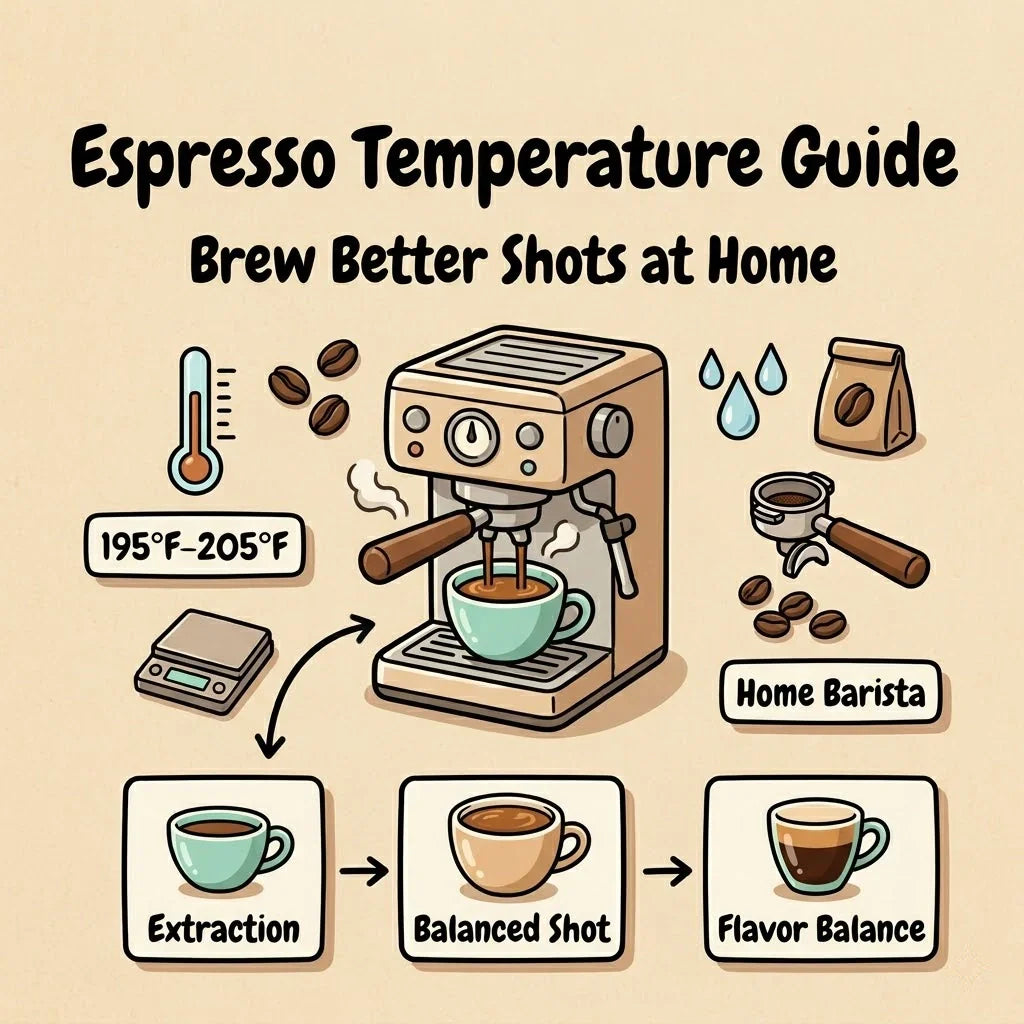
Most coffee professionals recommend brewing espresso within a range of 195°F to 205°F (90°C to 96°C). This window is where the flavor compounds in most coffee beans extract efficiently and in the right balance.
But this range is a guideline, not a single target. Within it, small adjustments create measurably different results:
- Brewing closer to 195°F (90°C) tends to produce a brighter, more acidic cup with less bitterness
- Brewing closer to 205°F (96°C) pulls more body and sweetness, but raises the risk of over-extraction if other variables are not in check
- Most home baristas find a reliable starting point around 200°F (93°C) for medium roast beans
The reason there is no single perfect espresso temperature is that coffee is not uniform. Bean origin, roast level, grind size, and how fresh the coffee is all interact with temperature to shape the final flavor. Treating espresso temperature as a range to work within gives you far more useful control than chasing one fixed number.
How Espresso Temperature Shifts by Roast Level
Roast level is one of the most practical reasons to adjust your espresso temperature. Different roast profiles respond very differently to the same water temperature, and knowing the general principles helps you make smarter decisions at the coffee machine.
Light Roasts and Higher Temperatures
Light roast beans are denser and less porous than darker roasts. They need slightly more thermal energy to extract fully, which means they generally benefit from temperatures toward the higher end of the recommended range, around 200°F to 205°F (93°C to 96°C).
Brewing a light roast too cool often results in a sharp, sour shot that lacks sweetness and body. The complex floral and fruity notes that make light roasts appealing only come through when extraction is complete enough to pull the deeper flavor compounds out of the bean.
Dark Roasts and Lower Temperatures
Dark roast beans have already gone through significant chemical changes during roasting. Many of the bitter compounds sit closer to the surface and extract quickly. Keeping the temperature in the lower part of the range, around 195°F to 200°F (90°C to 93°C), gives dark roasts a smoother, more balanced result. It preserves the richness without amplifying the bitterness that can dominate a shot pulled too hot.
Common Espresso Shot Problems Caused by Wrong Temperature
Flavor is the clearest feedback loop for espresso temperature. When something tastes off, brew temperature is often the first variable worth checking.
- Sour or thin shot: Points to under-extraction. The water may be too cool to dissolve the full range of flavor compounds. Try increasing espresso brew temperature by two to three degrees before adjusting anything else.
- Bitter or harsh shot: Suggests over-extraction. The temperature is pulling compounds too aggressively. A small reduction usually brings the shot back into balance.
- Flat or low-aroma shot: Often caused by temperature inconsistency during extraction, producing uneven results across the coffee puck that read as muted rather than balanced.
Small, incremental changes of two to three degrees at a time make it easier to identify what is shifting in the cup.
How Temperature Control at Home Affects Your Espresso Results
Consistent espresso at home depends on maintaining stable temperature throughout the entire extraction, not just reaching the right number at the start.
Many home machines use a thermoblock heating system, which is a compact element that heats water rapidly on demand. This design is well suited to home use and supports fast heat-up times. The quality of the result depends on how accurately the machine holds that temperature from the first second of the shot to the last.
Machines with an NTC temperature control system, where NTC stands for Negative Temperature Coefficient, go a step further. An NTC sensor monitors water temperature in real time and makes continuous adjustments to keep it within the target range during brewing. Some home machines with NTC systems also offer multiple preset temperature settings, letting you match the brew temperature to the roast you are using.
For espresso at home, that adjustability has real practical value. Shifting between a light roast and a dark roast becomes a deliberate setting rather than a guessing exercise, and the machine supports consistency rather than adding its own variables to the cup.
Dial It In, Cup by Cup
Espresso temperature is one of the smallest adjustments a home brewer can make and one of the most impactful. A few degrees separates a sour shot from a balanced one, and a flat result from a cup with genuine depth. Start by matching your temperature to your roast level, adjust one variable at a time, and let the flavor guide what comes next. A machine with precise, adjustable temperature control makes that process faster and far more repeatable.
FAQs
Q1. What Is the Best Temperature for Espresso?
Most coffee professionals and industry standards point to a range of 195°F to 205°F (90°C to 96°C) as the best espresso temperature for home brewing. Within that range, 200°F (93°C) is a reliable starting point for medium roast beans. The exact ideal shifts depending on roast level, bean origin, and personal taste preference, which is why machines with adjustable temperature settings give home brewers a meaningful advantage.
Q2. How Long Should a Home Espresso Machine Warm Up Before Pulling a Shot?
Most home espresso machines need at least 15 to 30 minutes to reach a fully stable brewing temperature. Running a blank shot, which is a cycle with no coffee in the portafilter, before your first real espresso helps flush out cooled water and brings the group head to the correct temperature. Skipping the warm-up period is one of the most common causes of inconsistent espresso at home.
Q3. Should Espresso Be Pulled in 25 or 30 Seconds?
Both fall within the generally accepted extraction window of 25 to 30 seconds, and the right choice depends on your specific setup. Espresso brew temperature and grind size both influence how quickly water moves through the coffee puck, so a slight temperature increase can extend extraction time while a decrease will speed it up. When a shot is running too fast or too slow, adjusting temperature is one of the first levers worth trying before reaching for the coffee grinder.
Q4. What Temperature Is Starbucks Espresso Brewed At?
Commercial espresso machines used in professional settings typically operate within the same 195°F to 205°F (90°C to 96°C) range that home baristas target. The consistency at that level comes from precise temperature control systems that maintain stability across back-to-back shots throughout the day. For espresso at home, machines equipped with accurate temperature regulation can achieve results within the same reliable range.