
Your morning cup and your café order might both be called "coffee," but the machines behind them operate on completely different principles. Whether you are drawn to a coffee maker or an espresso machine, the brewing method shapes everything: flavor, texture, strength, and ritual.
How a Coffee Maker and an Espresso Machine Work Differently
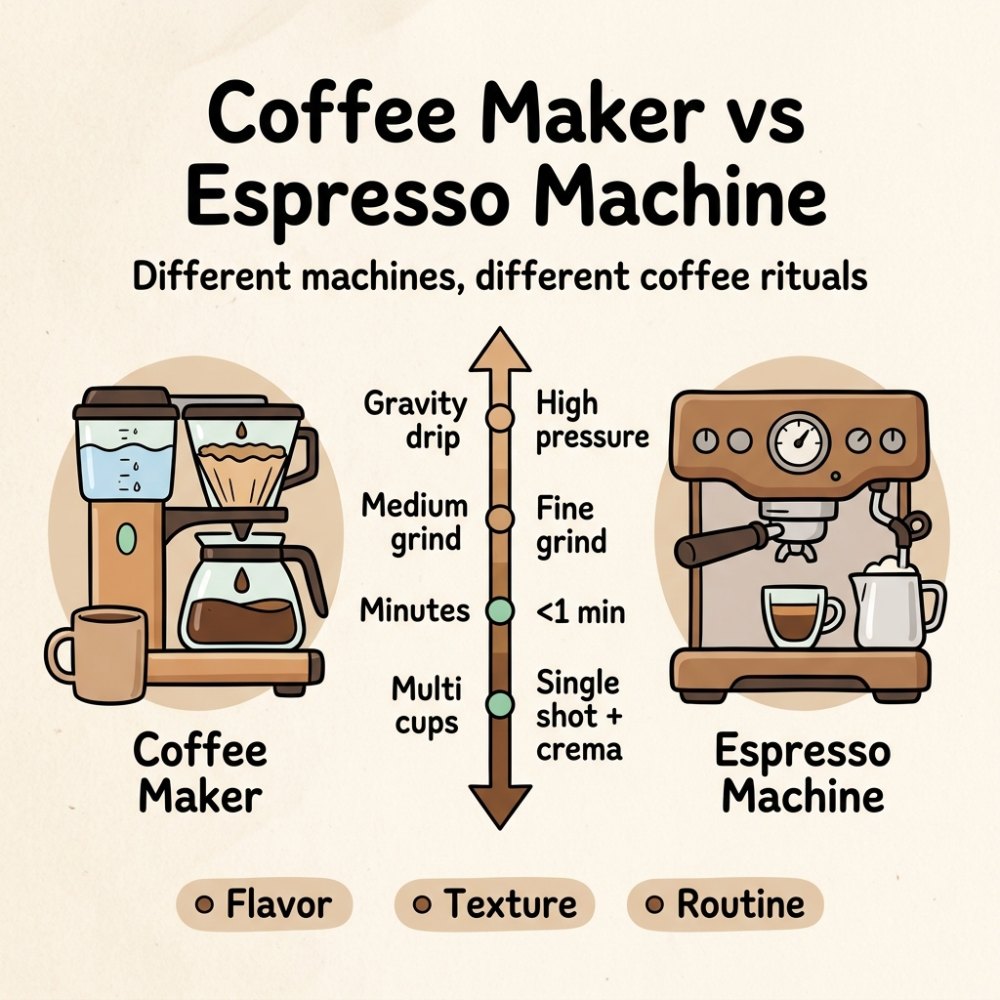
Both machines use hot water and ground coffee. That is where the similarity ends. The mechanics behind each method produce fundamentally different results, and those differences start long before the liquid hits your cup. The table below breaks down the key technical variables side by side.
| Variable | Coffee Maker | Espresso Machine |
| Brew method | Gravity-fed drip | High-pressure pump extraction |
| Grind size | Medium | Fine |
| Brew time | Several minutes | Under one minute |
| Output volume | Multiple cups per cycle | Single concentrated shot |
| Crema produced | No | Yes |
| Milk-based drinks | Not compatible | Yes, via steam wand |
| Ease of use | Minimal setup, very forgiving | Requires technique and practice |
Once you see these differences laid out, it becomes clear that these are not two versions of the same tool. They are built for entirely different brewing philosophies — and entirely different cups.
What Makes the Espresso Machine Unique
The espresso machine is not simply a faster or stronger version of a coffee maker. It is a different category of brewing tool entirely, built around a specific philosophy of extraction and flavor concentration.
The Origin of Espresso and Why Pressure Became the Standard
Espresso as a brewing method originated in Italy in the early twentieth century. The goal was speed — a machine that could produce a single, high-quality cup to order, quickly, for a café full of customers. Early inventors discovered that forcing hot water through compressed coffee grounds under pressure produced a shot that was richer, more aromatic, and more complex than anything a slow drip could create.
That discovery became the foundation of the espresso coffee machine as it exists today. The Italian espresso tradition is not just cultural nostalgia. It established the technical benchmark — pressure-driven, short-extraction, concentrated brewing — that every modern espresso machine is still built around.
Crema, Concentration, and Flavor Intensity
A standard coffee maker produces a drink that is roughly water with dissolved coffee compounds. Espresso produces something closer to a liquid concentrate, and the difference is immediately visible and tasteable.
What espresso delivers that a drip coffee maker cannot:
- Crema: The layer of emulsified oils and CO₂ that floats on top of the shot. It signals proper extraction and contributes to both aroma and mouthfeel.
- Intensity: Espresso is far more concentrated by volume, delivering a stronger flavor profile in a smaller serving.
- Texture: The pressurized extraction process pulls more oils from the coffee, giving espresso a fuller, heavier body than drip coffee.
- Versatility: Espresso serves as the base for lattes, cappuccinos, flat whites, and macchiatos — drinks that simply cannot be replicated with drip-brewed coffee.
Choosing Between a Coffee Maker and an Espresso Machine

Neither machine is objectively better. The right choice depends on what you drink, how you like to brew, and what features matter most to you in a morning routine.
Drink Style and Daily Routine
Think about what you actually reach for each morning:
- Large-volume, smooth coffee for the whole household — a drip coffee maker is the stronger fit. Look for features like a programmable 24-hour timer that has your coffee ready when you wake up, adjustable brew strength settings for regular or bold output, and a vacuum-sealed thermal carafe that keeps coffee hot for hours without a heating plate. A pause-and-serve function lets you pour a cup mid-brew without stopping the cycle.
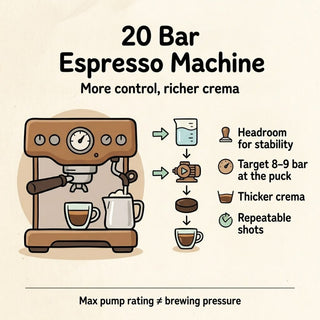
- Milk-based espresso drinks like lattes, cappuccinos, or flat whites — an espresso machine is the only way to replicate these at home. You need a high-pressure pump to pull a concentrated shot and a steam wand to texture the milk properly. Fast heating systems that deliver a shot in under a minute make this practical for daily use, not just weekend brewing.
- A mix of both — some households keep one of each, using a coffee maker for everyday volume and an espresso machine for specialty drinks. Both types of machine can coexist comfortably on a standard kitchen counter.
Control, Convenience, and What Each Machine Handles for You
This is where the two machines diverge most in day-to-day experience:
- Drip coffee makers are built around smart automation. A touchscreen interface, programmable start times, and selectable brew strengths mean the machine does the heavy lifting. A reusable permanent filter removes the need for paper filters entirely, and a wide-mouth carafe makes cleanup straightforward.
- Espresso machines are built around fast, precise extraction with intuitive controls. A touchscreen or clearly labeled button layout handles single shots, double shots, steam, and one-touch descaling without requiring any technical background. The machine manages pressure and heating automatically — your main input is loading the portafilter and choosing your shot size.
- Both reward the user who pays a little attention — adjusting brew strength on a coffee maker or choosing between single and double shots on an espresso machine both give you meaningful control over the final cup, without demanding expertise to get good results.
Choose the Machine That Matches It
The coffee maker and the espresso machine each do their job well. One is built for volume, simplicity, and everyday ease. The other is built for intensity, precision, and café-quality drinks that start with a concentrated shot. Knowing how they differ technically makes the choice a lot clearer. Think about the cup you actually want each morning, and work backward from there — the right machine will follow naturally.
FAQs about espresso health, brewing, maintenance
Q1. Is Espresso Healthier Than Coffee?
Neither is universally healthier — it depends on how each is consumed. Espresso is more concentrated, so it delivers more caffeine and antioxidants per ounce, but a typical serving size is much smaller than a drip coffee cup. When you factor in total volume, the caffeine and compound levels often end up comparable. Adding sugar, syrups, or full-fat milk to either drink will have a bigger impact on health outcomes than the brewing method itself.
Q2. What Is the Golden Rule of Espresso?
The golden rule refers to the target ratio of ground coffee to liquid espresso in the final shot. Baristas generally aim for a specific ratio of dry coffee grounds to extracted liquid, pulled within a set time window. Staying within this range produces a balanced shot with proper sweetness, acidity, and body. Deviating too far in either direction — too fast or too slow, too little coffee or too much — leads to under-extraction or over-extraction, both of which noticeably affect flavor.
Q3. Do You Stir Espresso Before Drinking?
Some people do, and there is a practical reason for it. The crema (the reddish-brown foam on top of the shot) and the denser liquid below it have slightly different flavor profiles. Stirring briefly combines them into a more uniform taste from the first sip to the last. It is a matter of personal preference rather than a hard rule, but baristas and enthusiasts who taste espresso as part of quality evaluation often stir before drinking.
Q4. Which Machine Is Harder to Maintain?
Espresso machines generally require more regular maintenance. The internal components — group head (the part where the portafilter locks in and water is dispensed), steam wand, and pump — need periodic cleaning and descaling to perform consistently. Coffee makers are simpler mechanically and easier to clean, though descaling is still recommended regularly. The complexity of upkeep is proportional to the complexity of the machine itself.