
That little number on the box, "20 bar," might look like just a spec. But for espresso lovers, it tells a story about flavor, texture, and what ends up in your cup. A 20 bar espresso machine pushes hot water through finely-ground coffee at extreme pressure, pulling out oils and compounds that lower-pressure machines simply miss. The result? A shot that is bold, layered, and topped with a golden crema that signals a well-pulled brew.
The Science of Pressure in a 20 Bar Espresso Machine
Espresso is built on extraction, the process of dissolving flavor compounds out of coffee grounds using hot, pressurized water. Pressure is the engine that makes this happen quickly and completely. Here is why the right pressure level makes such a noticeable difference in what ends up in your cup.
How High Pressure Pulls Full Flavor from Your Coffee Grounds
When water is forced through a tightly-packed coffee puck, the compressed disc of ground coffee inside the portafilter (the handle-shaped filter holder you lock into the machine), it does not simply flow through. It saturates every particle and pulls out a full spectrum of flavor:
- Bright, acidic top notes that lift the aroma
- Sweet mid-tones that give the shot body and balance
- Deep, earthy base notes that create a lingering finish
Pressure level directly controls how much of each layer you get:
- Too little pressure under-extracts the coffee, leaving it thin and sour
- Too much active pressure over-extracts, turning the shot harsh and bitter
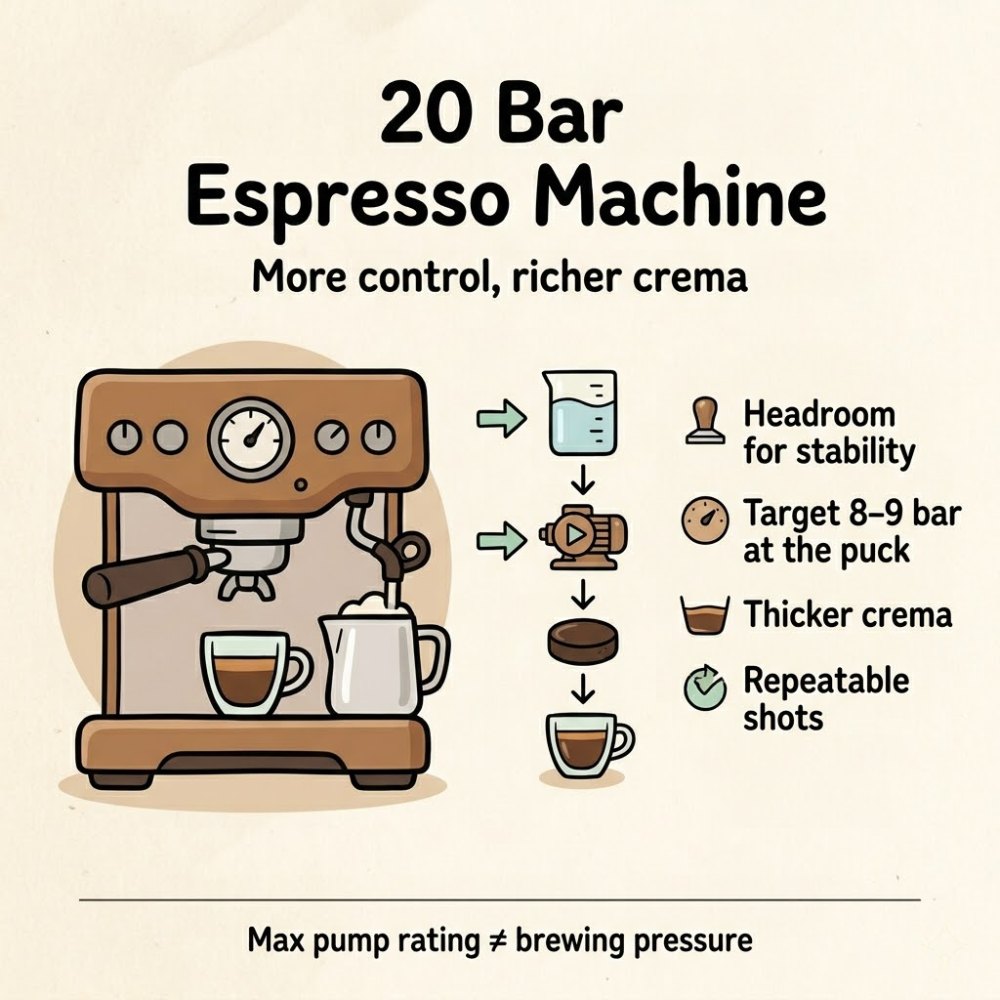
- The right range (8 to 9 bars at the puck) extracts everything in balance

A pump rated at 20 bars gives the machine the headroom it needs to hold that optimal range steady, even as resistance inside the coffee puck shifts throughout the shot. It is not about brute force. It is about having enough reserve to maintain control from the first drop to the last.
Why 20 Bars of Pressure Creates a Thicker, Richer Crema
Crema, the honey-colored foam that sits on top of a well-pulled espresso shot, forms when carbon dioxide (CO₂), a gas trapped inside freshly-ground coffee, gets dissolved into the liquid under pressure and then released as the shot hits the cup. More pump pressure means more CO₂ is driven into the brew, producing a thicker, more stable crema layer.
That crema is doing more work than it looks:
- Traps and concentrates aroma before you take your first sip
- Slows heat loss, keeping your shot warmer for longer
- Adds a lightly bitter, complex note that balances the sweetness below it
- Acts as a visual cue that extraction was done correctly
A thin or spotty crema usually signals under-pressure brewing. A proper 20 bar espresso machine is specifically designed to prevent that from happening.
Professional Espresso Machine Quality, Right on Your Countertop
Walk into any specialty coffee shop, and you will notice the barista working with a large, commercial-grade machine. What sets those machines apart is not just size. It is a set of core technologies working together. For a long time, replicating that at home meant spending a small fortune. That gap has largely closed.
A modern professional espresso machine designed for home use now combines the same fundamental capabilities found in commercial setups:
- Thermoblock heating is a system that heats water directly on demand inside a metal block, rather than maintaining a full boiler. This reduces wait time and keeps water temperature consistent shot after shot.
- NTC temperature control is a sensor-based system that continuously monitors and adjusts brewing heat, so precision does not drift between cups.
- A manual steam wand lets you texture milk for lattes, cappuccinos, and flat whites with hands-on control over foam density and temperature.
- An intuitive touchscreen puts single shots, double shots, manual mode, and one-touch descaling all within easy reach.
- A compact stainless-steel build fits a real kitchen counter without sacrificing durability.
The main difference from commercial equipment is scale. Commercial machines are built for high-volume output. Home machines are built to produce quality per shot. For the daily coffee drinker, that is exactly what matters most.
How to Choose a High End Espresso Machine That Delivers
Not all espresso machines are built the same. When evaluating a high end espresso machine, it pays to look past the bar rating and examine the full picture. The features below are the ones that genuinely shape day-to-day performance.
Temperature Stability and Build Quality
Extraction temperature is one of the most sensitive variables in espresso-making. Even a small swing in brewing heat can push your shot from sweet and balanced to flat and sour. A quality machine maintains a well-calibrated brewing temperature shot after shot.
On the build side, these are the features worth checking before you buy. The table below outlines what to look for and why each detail matters in practice.
| Feature | What to Look For | Why It Matters |
| Body material | Stainless-steel exterior | Durable, heat-resistant, easy to wipe clean |
| Water tank | Removable, with visible fill line | Simple to refill; helps prevent dry-run damage |
| Portafilter lock | Firm, secure-fitting mechanism | A loose fit causes uneven pressure and messy shots |
| Cup-warming tray | Top-mounted heated surface | Pre-warmed cups slow heat loss in the espresso shot |
| Descaling | One-touch automated function | Keeps internals clean and extends machine lifespan |
Machines that check all of these boxes tend to perform reliably for years, and make the daily brewing process noticeably more enjoyable along the way.
Steam Wand Performance and Ease of Use
Milk texture is the final piece of the espresso puzzle. Whether you are making a flat white, a latte, or a cappuccino, the steam wand, the metal nozzle that injects pressurized steam into milk to create foam, determines the quality of your drink.
A well-designed steam wand gives you manual control. By adjusting the angle and depth of the wand in the milk, you can produce microfoam (smooth, velvety foam with tiny, uniform bubbles, the style used for latte art) for drinks like lattes, or drier, thicker foam for cappuccinos. A powerful wand heats milk quickly and evenly, giving you full control over foam texture and temperature.
Beyond the wand, ease of use tells you a lot about how much thought went into the design. Signs of a well-thought-out home espresso machine include:
- An intuitive touchscreen or clearly-labeled button layout
- Single and double-shot options accessible without extra steps
- Auto shutoff after inactivity to save energy
- One-touch descaling, the process of flushing mineral deposits from internal components, so routine maintenance never feels like a chore
These are not extras. For a machine you are going to use every morning, they are what turn capable equipment into equipment you genuinely enjoy using.
Your Next Great Cup Starts Here
A 20 bar espresso machine closes the gap between home coffee and café coffee in a way that lower-pressure machines simply cannot. Pressure, temperature stability, and a capable steam wand all work together to shape what ends up in your cup. If bold flavor, rich crema, and consistent results matter to you, the right machine makes all the difference.
FAQs
Q1. What Is the Difference Between a 20 Bar and 15 Bar Espresso Machine?
The bar rating refers to the maximum pump pressure the machine can generate, not the pressure applied during brewing. Both types typically brew at 8 to 9 bars of active pressure at the coffee puck. The real difference is headroom: a 20 bar pump maintains that target range more consistently as resistance inside the puck changes mid-shot. In practice, this shows up as better crema, more even extraction, and more repeatable results cup after cup.
Q2. What Common Mistakes Ruin Espresso?
The most common issue is grind size. Espresso needs a fine, even grind; too coarse and the shot runs weak, too fine and it turns bitter. Inconsistent tamping is another culprit, since uneven pressure causes water to channel through weak spots in the puck. Beyond technique, neglecting descaling and using stale beans will quietly degrade flavor no matter how good your machine is.
Q3. Can I Use Regular Ground Coffee for Espresso?
Technically yes, but standard pre-ground coffee is milled for drip brewing, which makes it too coarse for espresso. Water passes through it too quickly, producing a weak, watery shot with little crema. For best results, use a blend specifically labeled as espresso grind. It is finer, creates the right resistance against high-pressure water flow, and performs noticeably better through a 20 bar machine.
Q4. What Is the Difference Between a Semi-Automatic and a Fully Automatic Espresso Machine?
A semi-automatic machine lets you control when the shot starts and stops, giving you direct influence over extraction time and strength. A fully automatic machine handles that timing on its own, prioritizing speed and repeatability. Semi-automatic models tend to suit home baristas who want hands-on control, while fully automatic machines are a better fit for anyone who wants a reliable cup with minimal decision-making. Both are available with 20 bar pumps and professional-grade features.