
Two grinders can sit side by side on a store shelf and look almost identical from the outside. Inside, though, they could not be more different. The type of grinder you use shapes the flavor of every cup you make, starting with the very first grind. Whether you are considering a burr grinder for the first time or wondering if your current setup is holding your coffee back, the comparison below covers what actually matters.
Quick Takeaways
- A burr grinder crushes beans uniformly. A blade grinder chops unevenly.
- Uneven grounds cause bitter or flat coffee.
- Burr grinders suit all brew methods. Blade grinders work best for basic drip coffee.
- For daily brewing and better flavor, a burr grinder is the stronger choice.
What Is a Burr Grinder and How Does a Blade Grinder Differ
Before comparing the two, it helps to know exactly what each one is.
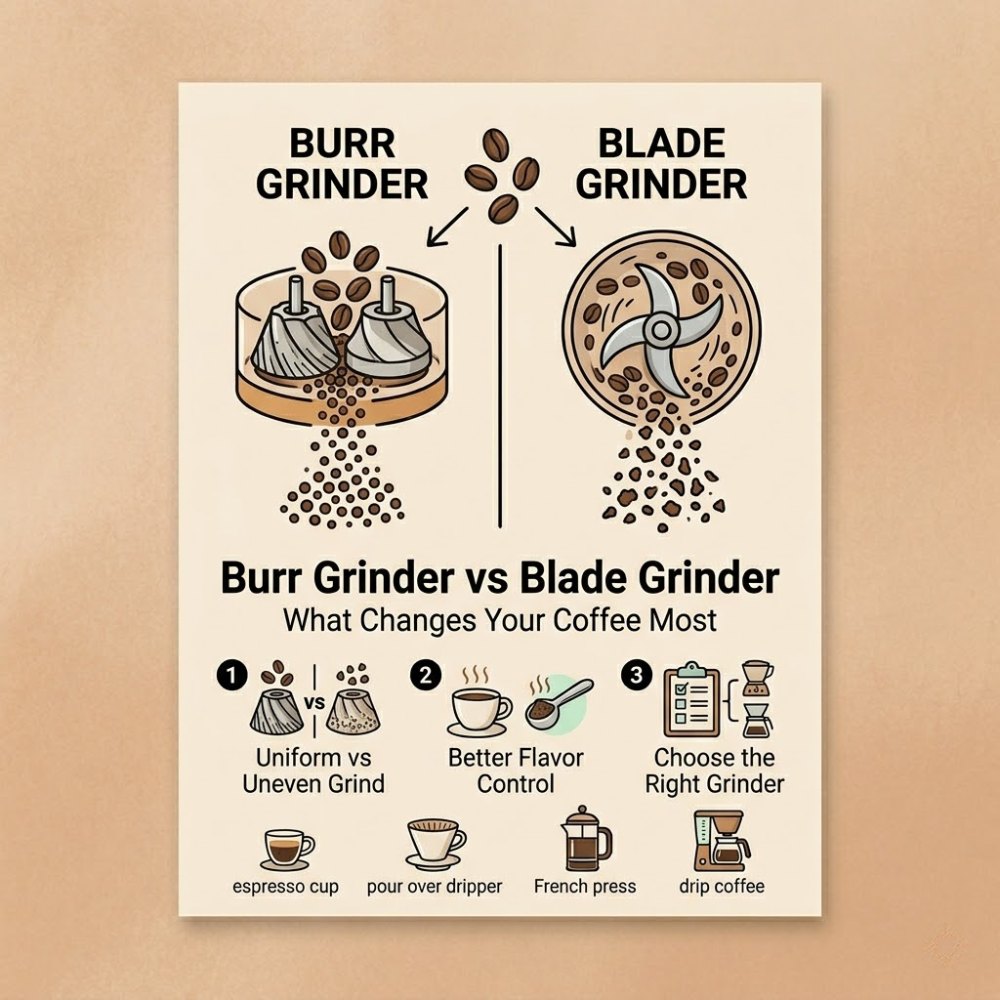
A burr grinder is a type of coffee grinder that crushes beans between two revolving abrasive surfaces called burrs. The gap between the burrs controls the size of the grounds, which can be adjusted for different brewing methods. Burr grinders come in two main styles: conical burr (where one cone-shaped burr rotates inside another) and flat burr (where two disc-shaped burrs face each other horizontally).
A blade grinder uses a single spinning metal blade to chop coffee beans. It operates differently from a burr grinder, using a spinning metal blade to chop beans rather than crushing them between two surfaces. Because the blade does not apply uniform pressure across all the beans, it produces a mix of fine and coarse particles in every batch.
Both are designed to grind coffee beans, but how they get there is entirely different.
How Each Grinder Type Works
Knowing what each grinder is made of only tells part of the story. How they actually function during grinding reveals why the results differ so much.

How a Burr Grinder Works
A burr grinder feeds whole beans through a chute and into the space between two burrs. As the burrs spin, they crush the beans by pressing them together. The distance between the burrs is fixed and adjustable, so every particle that passes through comes out at roughly the same size. This is known as a uniform grind, and it is what makes burr grinders the preferred choice for precision brewing.
How a Blade Grinder Works
A blade grinder operates by spinning a sharp metal blade at high speed inside a small chamber. Beans get chopped repeatedly until the user stops the machine. Because there is no mechanism to control particle size, the longer you run it, the finer the grind becomes. Beans near the blade get chopped more than those near the edges, producing a mix of fine and coarse particles in each batch.
Grind Consistency and Why It Matters
Of all the differences between a burr grinder and a blade grinder, grind consistency has the most direct impact on your cup.
When coffee grounds are uneven in size, water moves through them at different rates during brewing. Fine particles absorb water too quickly and over-extract, producing bitter flavors. Coarse particles absorb water too slowly and under-extract, producing sour or weak flavors. Both happen at the same time when grind size is inconsistent, which is why the cup can taste muddled or off even when everything else is done right.
The table below outlines the core differences at a glance.
| Factor | Burr Grinder | Blade Grinder |
| Grind uniformity | High | Low |
| Grind size control | Adjustable | Limited |
| Heat generated | Low | Higher |
| Best suited for | All brew methods | Basic drip coffee |
| Ease of use | Moderate | Very easy |
For casual brewing where consistency is less critical, a blade grinder can get the job done. For methods that require a precise grind size, such as espresso or pour-over, a burr grinder delivers far more reliable results.
How Grinder Choice Affects Your Coffee Taste
Grind consistency is a technical detail, but its effects show up directly in what you taste.
Coffee brewed with grounds from a burr grinder tends to taste cleaner and more balanced. Because the particles are uniform, water extracts flavor evenly across all of them. The result is a cup that reflects the actual character of the bean, whether that means bright acidity, natural sweetness, or deep roasted notes.
Coffee brewed with grounds from a blade grinder is harder to control. The mix of fine and coarse particles means some flavor compounds are over-extracted while others are under-extracted at the same time. The cup may taste less balanced, which can make it harder to highlight the natural character of the bean.
The difference is most noticeable with brewing methods that are sensitive to grind size, including espresso, French press, and pour-over. For standard drip coffee, the gap in taste quality is smaller but still present.
How to Choose the Right Coffee Grinder for Your Needs
The right grinder depends on how you brew, how often you brew, and what you value most in a cup. A few factors worth thinking through:
- Brewing method: Espresso, pour-over, and French press all require a specific grind size to work properly. A burr grinder gives you the control to hit that target consistently. Drip coffee is more forgiving and can work reasonably well with either type.
- Frequency of use: If you brew every day and care about flavor, a burr grinder is a worthwhile long-term investment. If you brew occasionally and convenience is the priority, a blade grinder is simpler to operate.
- Budget: Blade grinders are generally more affordable upfront. Burr grinders have a wider price range, with entry-level options available for most home brewers.
- Counter space: Blade grinders are compact and lightweight. Burr grinder sizes vary, with many models designed to fit comfortably on a standard countertop.
There is no universal right answer. A blade grinder works well for someone who brews simple drip coffee and values ease of use above all. A burr grinder is the better fit for anyone who wants more flavor control and brews with methods that are grind-sensitive.
Find the Grinder That Fits Your Morning
The choice between a burr grinder and a blade grinder comes down to what you expect from your coffee. A blade grinder keeps things simple and accessible. A burr grinder offers the consistency and control that shows up in every cup. If flavor quality matters to you, starting with the right grinder is one of the most effective steps you can take.
FAQs about Coffee Grinder Types
Q1. Can a Blade Grinder Be Used for Espresso?
A blade grinder can technically grind beans fine enough for espresso, but the inconsistent particle size makes it very difficult to pull a balanced shot. Espresso requires a precise and uniform grind to build the right pressure during extraction. For espresso, a consistent and precise grind size is important for proper pressure and extraction, which is why burr grinders are generally the more suitable choice for this brewing method.
Q2. Do Burr Grinders Work With All Types of Coffee Beans?
Yes, burr grinders work with all roast levels and bean varieties. The adjustable settings allow you to dial in the right grind size whether you are using a light roast for pour-over or a dark roast for French press. The grinder performs consistently regardless of the bean origin or roast profile.
Q3. How Long Does a Burr Grinder Typically Last?
With regular cleaning and proper use, a quality burr grinder can last for many years. The burrs themselves wear down gradually over time, but replacement burrs are available for many models. Keeping the grinder clean and avoiding overloading it helps extend its lifespan significantly.
Q4. Is a Blade Grinder Suitable for Grinding Spices as Well?
Many people use blade grinders for both coffee and spices, but mixing the two without thorough cleaning in between is not recommended. Spice oils and residue can transfer to coffee beans and noticeably affect the flavor of your brew. If you grind spices regularly, keeping a separate blade grinder for that purpose is a practical and easy solution.