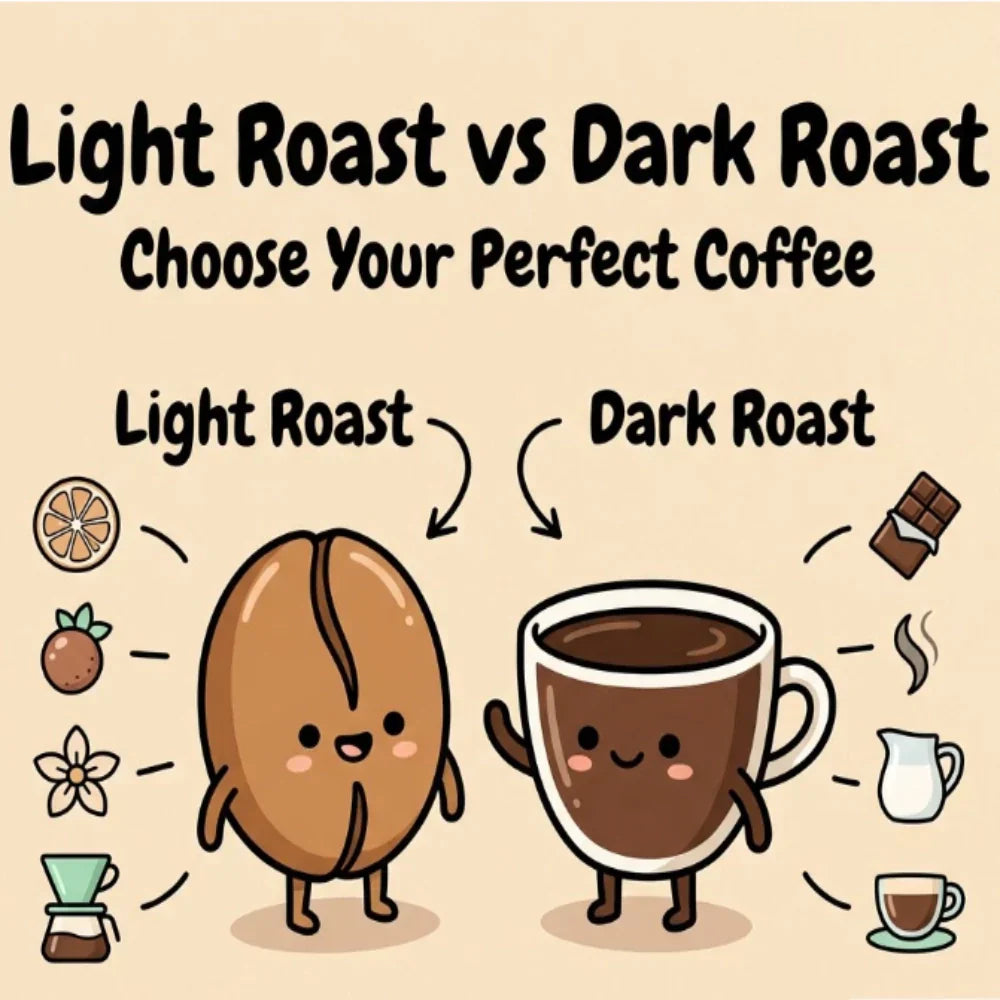
Most coffee drinkers pick their bag by packaging color or the word "Bold" on the label. It works, sort of, but it also means you're leaving a lot of flavor on the table. Dark roast coffee and light roast coffee taste fundamentally different for scientific reasons, not just marketing ones. Once you know what actually happens inside the bean during roasting, choosing between the two becomes a lot less random and a lot more satisfying.
Quick Answer
| Roast | Choose If You… |
| Light Roast | Prefer fruity, bright, and complex flavors |
| Drink your coffee black | |
| Love pour-over or black coffee brewing | |
| Dark Roast | Want bold, smoky, and chocolatey flavors |
| Add milk or cream to your coffee | |
| Brew espresso or use a French press | |
| Prefer a low-acid cup |
Keep reading to find out why roast level affects a lot more than just flavor.
How Roasting Changes the Flavor of Coffee Beans
A green, unroasted coffee bean is dense, grassy, and completely undrinkable. Heat is what transforms it.

Two key reactions happen during roasting. The Maillard reaction browns proteins and sugars under heat, creating hundreds of new flavor compounds. Caramelization breaks down the bean's natural sugars into sweeter, more complex notes. How far these reactions go depends on roasting time and temperature.
- Light roast: Pulled from the drum around 356–401°F, at or just after the "first crack" (an audible pop as moisture escapes the bean). The bean's original character stays mostly intact.
- Dark roast: Roasted longer, reaching 437–482°F past a "second crack." Original flavor compounds break down and are replaced by bitter, smoky, and chocolatey notes.
Dark roast beans also end up more porous and brittle, while light roast beans stay denser and harder. That physical difference directly affects how each roast should be ground and brewed.
What Light Roast Coffee Really Tastes Like
Light roast has a reputation for being mild or weak. That reputation is not accurate.
Because the bean is roasted less aggressively, its origin characteristics stay intact. A light roast Ethiopian bean might taste like berries and jasmine. A Colombian light roast might offer citrus and brown sugar. These flavors come directly from where and how the coffee was grown, not from the roasting process. The roast simply gets out of the way.
The flavor profile of light roast coffee generally includes:
- Bright, fruit-forward acidity (citrus, stone fruit, berries)
- Floral or herbal notes depending on origin
- A lighter body and thinner mouthfeel compared to dark roast
- Higher perceived brightness in the cup
Light roast suits people who drink coffee black and enjoy exploring single-origin beans. It also works well for pour-over (a manual brewing method where hot water is poured slowly and evenly over grounds) and Aeropress.
One practical note: because light roast beans are denser, they resist grinding slightly more than dark roast beans. They often benefit from a finer, more precise grind setting to extract evenly and avoid a flat or sour cup. A burr grinder with clearly defined grind settings makes this adjustment straightforward. The SHARDOR Coffee Burr Grinder with 16 Grind Settings covers the full range from fine espresso to coarse French press, so switching between roast levels is a simple click rather than a guessing game.
The Truth About Dark Roast Coffee Most People Get Wrong
Dark roast coffee dominates most supermarket shelves and most household coffee routines. It is familiar, approachable, and consistently popular. But several widely held assumptions about it do not hold up to scrutiny.
Caffeine Levels Are Not What You Think
The most common belief is that dark roast coffee contains more caffeine. It does not. Roasting actually breaks down caffeine slightly, so dark roast beans contain marginally less caffeine per gram than light roast beans. When measured by volume (scoops), the gap closes because dark roast beans are puffier and lighter, meaning you use more beans per scoop. Either way, the difference is small enough to be irrelevant in practice. Total coffee dose and brew method are what actually affect your caffeine intake.
Bold Flavor Does Not Equal Strong Coffee
The word "strong" in coffee typically refers to concentration: how much dissolved coffee is in your cup. That is a function of your brew ratio (the amount of coffee relative to water), not the roast level. A highly concentrated light roast can be objectively stronger than a diluted dark roast.
What dark roast coffee genuinely delivers is a distinct flavor character: smoky, chocolatey, low-acid, and full-bodied. These are legitimately appealing qualities for the right drinker. Dark roast is a natural fit for:
- Milk-based drinks like lattes and cappuccinos, where bold flavor holds up under milk
- Drinkers who prefer a low-acidity cup
- French press (an immersion brewing method that steeps grounds directly in hot water) and drip coffee makers
How to Choose Between Light Roast and Dark Roast Coffee for Home Brewing
The best roast is the one that fits both your taste preferences and your brewing setup. Flavor preference is personal, but brewing method compatibility is more predictable.
The table below covers the most common brewing methods and which roast level tends to perform better for each. These are starting points based on extraction characteristics, not hard rules.
| Brewing Method | Better Roast Match | Why It Works |
| Pour-over | Light roast | Slow extraction highlights fruit and complexity |
| Aeropress | Light or medium | Flexible method suits brighter flavors well |
| Drip coffee maker | Dark or medium | Consistent, forgiving, and reliable for daily use |
| French press | Dark roast | Heavy body suits immersion-style brewing |
| Espresso machine | Dark or medium | Bold flavors hold up under high-pressure extraction |
If you like drinking black coffee and want to taste where the bean came from, light roast is worth exploring. If you add milk, prefer a consistent cup with low acidity, or just want something dependable every morning, dark roast is the more predictable choice.
Beyond roast selection, grind size is the variable most home brewers overlook. Light roast beans benefit from a slightly finer grind to compensate for their denser structure. Dark roast beans are more porous and extract faster, so a slightly coarser grind setting helps bring out their best flavor. Getting those adjustments right makes a noticeable difference in the cup, regardless of which roast you prefer. For home brewers who want that level of control, the SHARDOR Professional 64mm Flat Burr Grinder offers 100 grind settings with a precise LED timer, making it easy to dial in any roast level consistently.
Start Brewing With Intention
Light roast coffee and dark roast coffee are not competing products. They are two different flavor experiences made from the same ingredient. Neither is stronger, neither has significantly more caffeine, and neither is the wrong choice. The best way to pick is to match your roast to how you brew and how you take your coffee. Pay attention to grind size. Make small adjustments. The difference between a good cup and a great one is usually simpler than people expect.
FAQs about Dark Roast Coffee
Q1. What Is the Point of Dark Roast Coffee?
Dark roast coffee is roasted longer and at higher heat, which replaces the bean's natural fruity notes with bold, smoky, and chocolatey flavors. It produces a low-acid, full-bodied cup that pairs well with milk and works great in drinks like lattes and cappuccinos. If you want a rich, consistent cup without a lot of brightness or complexity, dark roast is built for that.
Q2. Is a Darker Roast Coffee Stronger?
No, and this is one of the most common mix-ups people have about dark roast coffee. Strength in coffee comes from how much coffee you use relative to water, not from roast level. Dark roast tastes bolder and more bitter, but a well-dosed light roast can actually produce a more concentrated cup. Roast level changes the flavor, not the strength.
Q3. What Is the Difference Between Regular and Dark Roast Coffee?
"Regular" coffee usually means a medium roast, which sits between light roast and dark roast on the spectrum. Medium roast keeps some of the bean's original flavor while developing the caramelized, roasted notes most people are familiar with. Dark roast pushes that process further, resulting in a heavier body, lower acidity, and a more pronounced bitter and smoky profile compared to your everyday cup.