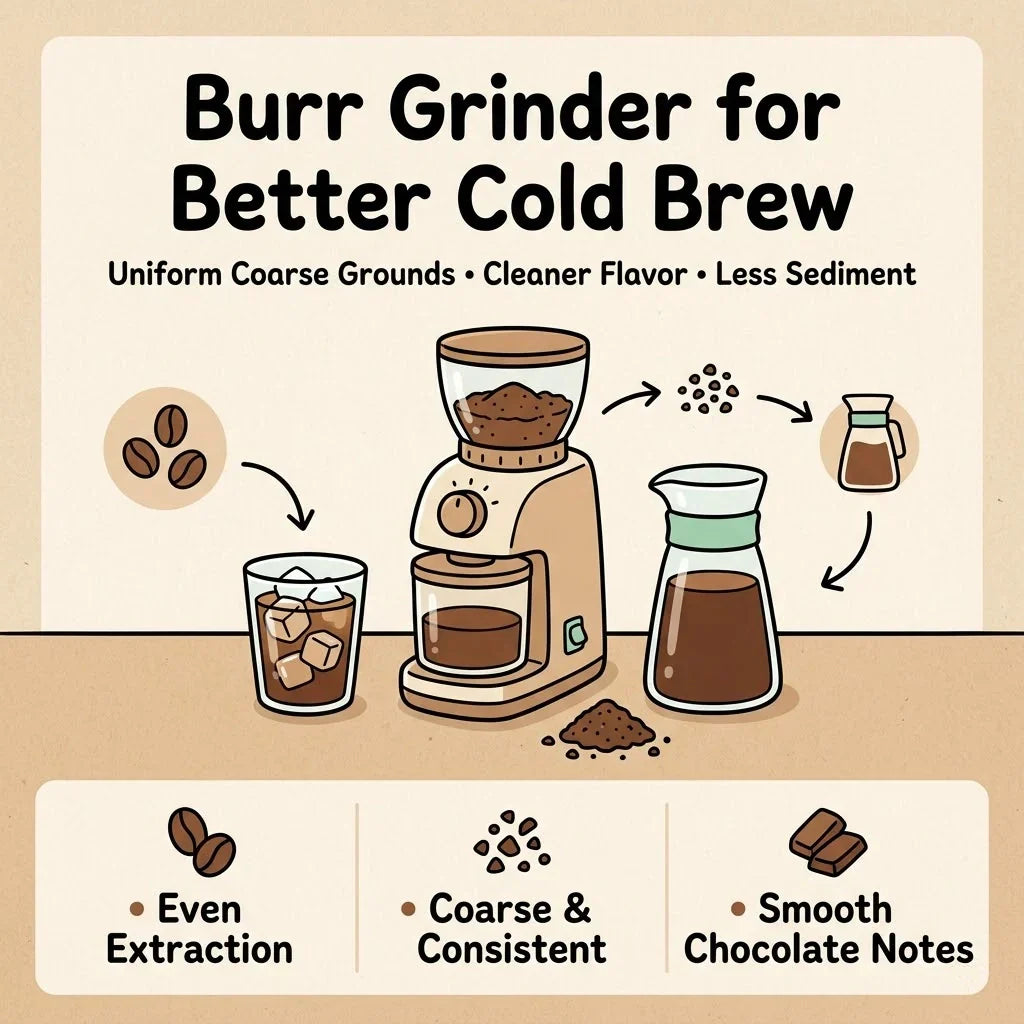
Many home brewers chase that smooth, chocolatey cold brew only to end up with a muddy, bitter mess. The hidden culprit is usually inconsistent grind size. A burr grinder for cold brew solves this by delivering uniform coarse particles that support even extraction over 12 to 24 hours.
The Science of Long Immersion Extraction During Summer
Cold brew relies on time instead of heat. Beans steep in room temperature or cold water for 12 to 24 hours. This long window makes grind consistency far more important than many beginners realize.
Water slowly penetrates every particle. Yet microscopic fines release their bitter compounds almost right away. Larger chunks may never fully extract. The result can be a single batch that tastes both overly bitter and strangely weak at the same time.
Research from the UC Davis Coffee Center confirms that grind size directly affects the rate and dynamics of extraction in full immersion brewing. Without heat to accelerate the process, inconsistencies in particle size stand out clearly in the final cup. As UC Davis coffee scientists explain, every step of an immersion brew has an effect on the final result, and grind size is one of the most controllable variables a home brewer can adjust.
Summer heat speeds up the process slightly when steeping at room temperature, which can magnify these issues if the grind is uneven. Uniform grounds become the main defense against sediment, bitterness, and flat flavor.
Consistency Gains from a Precision Coffee Burr Grinder

Blade grinders and burr grinders work in fundamentally different ways. A blade grinder spins metal blades at high speed, smashing beans into random sizes. The output often contains a wide mix of dust and large fragments.
A coffee burr grinder uses two ridged surfaces that rotate against each other. Beans pass through a fixed gap, so every particle ends up roughly the same size. This uniformity matters a lot for cold brew.
Fines, the tiny particles, create sediment that slips through most filters and clouds the pitcher. They also over extract during long steeps, adding bitterness. Boulders, the oversized pieces, stay under extracted and leave the brew tasting thin or sour.
Lower RPM burr grinders also generate less heat. This protects delicate oils that contribute to the signature chocolate notes. Many home brewers notice cleaner flavor and less sediment after switching.
If you have been disappointed by cloudy or harsh cold brew, the grinder is often the first place to look. Upgrade to an electric burr coffee grinder for noticeable improvement in everyday batches.
Finding the Perfect Setting on a Burr Grinder for Cold Brew
The right grind size for cold brew looks like coarse rock salt or sea salt. This extra coarse texture allows slow, even flavor release without excessive bitterness or sediment.
A burr grinder for cold brew gives you repeatable control. Start at the coarsest setting on your model. Grind a small test batch and inspect the grounds. Large boulders should be minimal. If you see noticeable powder at the bottom of the container, try adjusting one or two clicks coarser.
Adjust one or two clicks finer until the mix looks mostly uniform. Then lock that setting for future batches. This simple process removes the guesswork that comes with pulsing a blade grinder.
Cold brew grind size consistency directly affects your final cup. Uniform grounds reduce the chance of both over extraction from fines and under extraction from chunks. The longer the steep, the more this narrow particle band matters.
Practical checks you can do at home include:
- Rub a pinch of grounds between your fingers. They should feel mostly the same size with few powdery bits.
- After brewing and filtering, check for cloudiness or heavy sediment in the pitcher.
- Taste for balance. Strong chocolate notes without lingering bitterness or sour weakness signal success.
Mastering this target grind turns inconsistent weekend experiments into reliable daily cold brew.
Switching Gears to Use the Coffee Grinder for Espresso Later
Many enthusiasts want one machine that handles both cold brew and espresso. A quality burr grinder makes this possible. The wide range of settings lets you move from extra coarse rock salt for immersion to fine powder for espresso shots.
Models with dozens of precise steps give you the granularity to find and repeat sweet spots for each method. Anti static features become especially useful when switching to fine grinds. They keep coffee dust from coating your counter and the inside of the hopper.
The same uniformity that benefits cold brew also improves espresso. Consistent particles support even pressure and balanced flavor in the shot. This versatility makes a good burr grinder a smart long term investment for growing home setups.
When you change beans or roast levels, a quick dial adjustment and a quick purge of old grounds is usually enough. The grinder adapts with you instead of limiting your options.
For deeper insight into flavor clarity, see how larger burr sizes affect results in 64mm Burr Grinder: Improve Coffee Flavor Clarity. Pairing your grinder with the right equipment can help build a low sugar coffee routine that actually sticks, as discussed in Espresso Machine for Home: A Low-Sugar Coffee Routine That Actually Sticks.
Choosing the Right Grinder for Your Brewing Routine
Before buying a coffee burr grinder for cold brew, a few practical features are worth evaluating. The right choice depends on how you brew and how much flexibility you want down the road.
- Batch size and dosing: If you brew large pitchers several times a week, look for models with consistent dosing controls to keep each batch accurate.
- Removable parts: A grinder with removable burrs and a detachable grounds container makes cleaning between beans or grind settings much faster and prevents flavor crossover.
- Burr design: Conical burrs tend to run quieter and handle a wide grind range well. Flat burrs can deliver slightly more distinct flavor separation. Both outperform blade grinders for cold brew consistency.
- Number of grind settings: Enough steps to cover coarse cold brew and fine espresso means one grinder handles your full range without compromise. A machine that grows with your skills is a better long-term investment than one that limits your options.
Make the Switch to Better Cold Brew
Grind consistency is the variable most home brewers overlook, but it is the one that determines whether cold brew comes out clean and chocolatey or muddy and bitter. A coffee burr grinder gives you uniform coarse particles that support even extraction over a long steep, and enough range to dial in espresso when the occasion calls for it. If your current setup is holding your cold brew back, the grinder is the right place to start. Browse the full range of SHARDOR burr grinders and find the one that fits your routine.
FAQs about cold brew grind size
Q1. What Is the Ideal Coarse Grind Size for Cold Brew?
The ideal texture resembles coarse rock salt or sea salt. This size allows slow flavor release over 12 to 24 hours without creating excessive fines that cause bitterness. Test by feel and appearance. Uniform particles should dominate with very little powder visible.
Q2. Why Do Blade Grinders Often Produce Sediment in Cold Brew?
Blade grinders create a wide range of particle sizes in one batch. The fine dust slips through filters and settles in the pitcher. These particles also over extract quickly during long steeps. The result is cloudy texture and unwanted bitterness even when the rest of the brew seems fine.
Q3. How Often Should I Adjust My Burr Grinder Setting for Cold Brew?
Adjust when you change bean type, roast level, or brewing method. Once you find a setting that produces mostly uniform coarse grounds with minimal powder, you can usually reuse it for the same beans. Check output every few batches and adjust as needed to keep results consistent.
Q4. Can Inconsistent Grind Size Make Cold Brew Both Bitter and Weak?
Yes. Fines over extract into bitterness and mud while large chunks remain under extracted and thin. In a long immersion these opposite problems appear in the same pitcher. Uniform grounds from a burr grinder reduce this dual failure and help you reach balanced flavor more reliably.